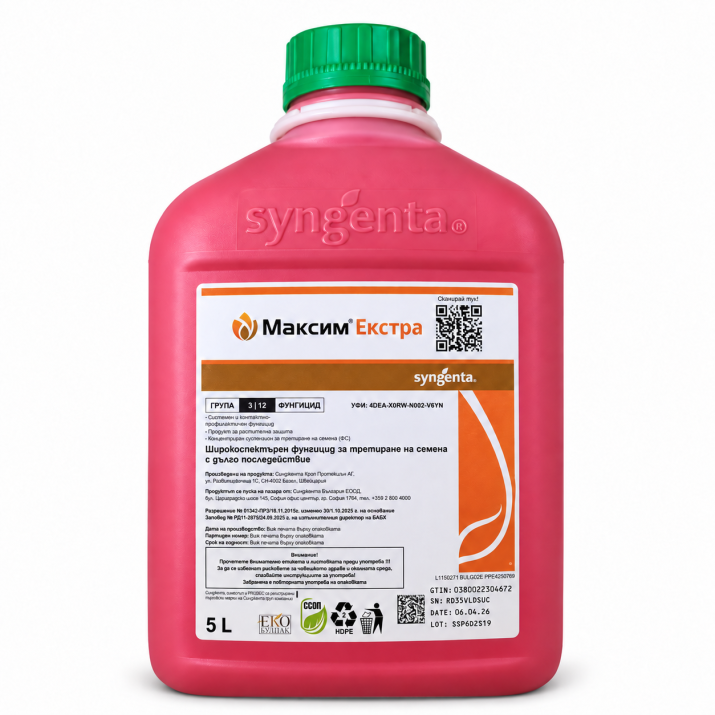
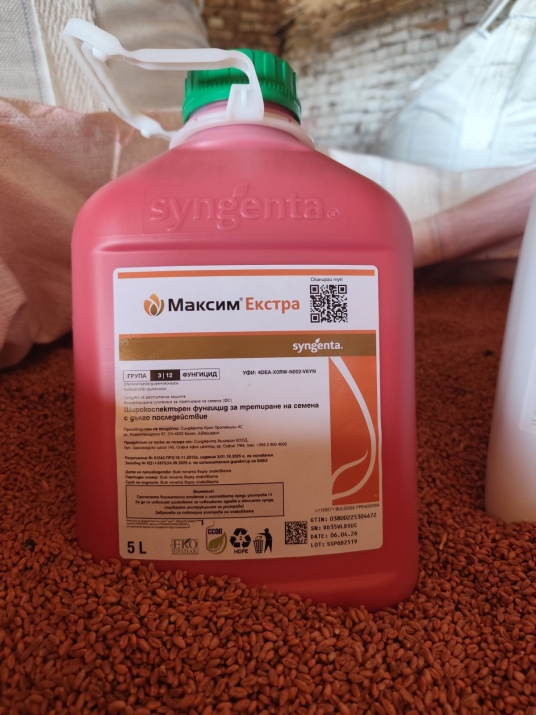
Maxim Extra - fungicide for seed treatment
Seed treatment fungicide with an exceptionally broad spectrum of disease control.

Print
Description
Advantages
Composition
Photos
Description
Maxim Extra offers an exceptionally broad spectrum of disease control and highly effective control against snow mold (*Monographella nivalis*) and *Fusarium* spp.
Advantages
- Maxim Extra provides powerful protection for cereal crops up to the point of emergence against all economically important soil-borne and seed-borne pathogens.
- Maxim Extra minimizes losses, ensuring a healthy and well-established crop stand.
- Treating seeds with Maxim Extra delivers a high return on investment, not only in areas with high yield potential but also in those with lower potential.
- Flexible application rates tailored to anticipated weather conditions and pathogen pressure.
Advice for treatment
- Seed treatment must be carried out using high-quality, specialized equipment designed for this purpose. Seed treatment is the sole and indispensable method for controlling seed-borne diseases in cereal crops;
- Do not mix with other seed treatment products containing organic solvents;
- The prepared working solution must be used on the same day;
- Treated seeds must be used solely for sowing; store treated seeds in a secure, cool, and well-ventilated area, properly labeled, and sow them as soon as possible;
- Shake the container vigorously before preparing the working solution;
- Workers performing the seed treatment must wear protective clothing and gloves.
Registered uses
| CROP | DISEASE | APPLICATION RATE | APPLICATION TIMING |
|---|---|---|---|
| Wheat | Common root rot (Cochliobolus sativus), Fusarium seedling blight (Fusarium spp.), Glume blotch (Leptosphaeria nodorum), Common bunt / Stinking smut (Tilletia caries), Dwarf bunt (Tilletia controversa) | 150–200 ml / 100 kg of seed | Seed treatment before sowing |
| Wheat | Snow mould (Monographella nivalis), Loose smut (Ustilago tritici) | 200 ml / 100 kg of seed | Seed treatment before sowing |
| Barley | Common root rot (Cochliobolus sativus), Fusarium seedling blight (Fusarium spp.), Leaf stripe (Pyrenophora graminea) | 150–200 ml / 100 kg of seed | Seed treatment before sowing |
| Barley | Snow mould (Monographella nivalis), Net blotch (Pyrenophora teres), Covered smut (Ustilago hordei) | 200 ml / 100 kg of seed | Seed treatment before sowing |
| Oats | Fusarium seedling blight (Fusarium spp.), Leaf blotch (Pyrenophora avenae) | 150–200 ml / 100 kg of seed | Seed treatment before sowing |
| Oats | Common root rot (Cochliobolus sativus), Septoria leaf and glume blotch (Septoria spp.), Loose smut (Ustilago avenae) | 200 ml / 100 kg of seed | Seed treatment before sowing |
| Rye | Fusarium seedling blight (Fusarium spp.) | 150–200 ml / 100 kg of seed | Seed treatment before sowing |
| Rye | Common root rot (Cochliobolus sativus), Snow mould (Monographella nivalis), Stem smut (Urocystis occulta) | 200 ml / 100 kg of seed | Seed treatment before sowing |
| Triticale | Common root rot (Cochliobolus sativus), Fusarium seedling blight (Fusarium spp.) | 150–200 ml / 100 kg of seed | Seed treatment before sowing |
| Triticale | Glume blotch (Leptosphaeria nodorum), Snow mould (Monographella nivalis), Tan spot (Pyrenophora tritici-repentis) | 200 ml / 100 kg of seed | Seed treatment before sowing |
Details
Active ingredient
DifenoconazoleФлудиоксонил
Formulation
Концентрирана суспензия за третиране на семена (ФС)
Category of usage
II Professional
Disease
Fusarium wiltHelminthosporiosisNet blotchSnow moldStripe diseaseYellow-brown spots
For crop
BarleyOatsRyeTriticaleWheat
Photos